Monday, September 6, 2010

Salt Burn and Stunted Growth - How Almonds Respond to Saline Conditions


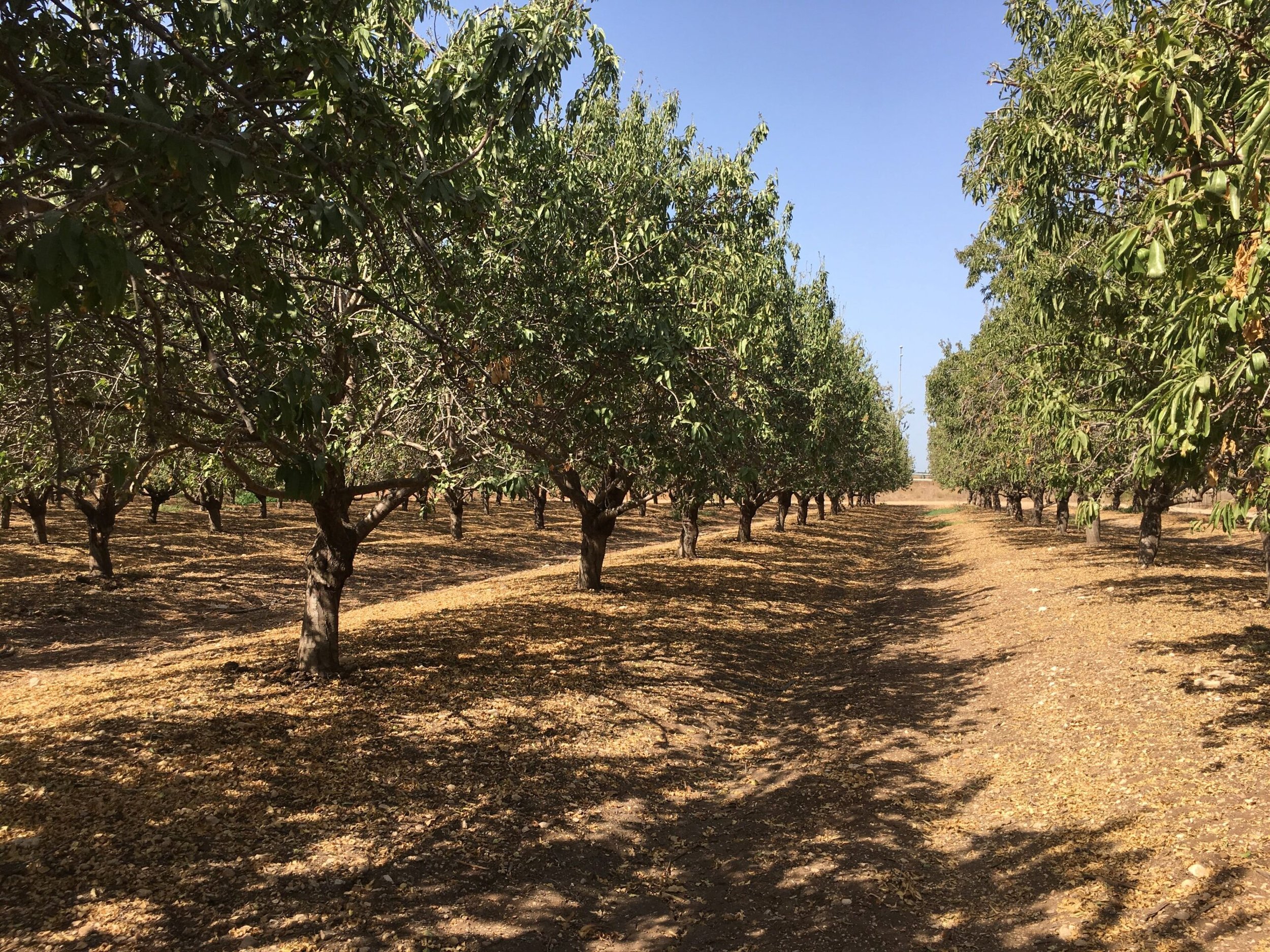
Some areas of California are prone to salt damage. Within Merced County, common salt affected areas include the Livingston/Atwater/Hilmar area. The soils in these areas are coarse (Sand to Loamy Sand) and, when irrigated with well water, accumulate high levels of sodium. In other places of California, which include areas of the San Joaquin Valley and Lower Sacramento Valley,  sodium, chloride, and boron can be problematic.

Salt burn is typically identified by tissue analysis. This analysis can be through visual or analytical observations. Leaf sampling in Mid-July can be compared to UC critical values to determine the relative level of salt. Severe salt burn appears late in the summer, with leaf tips burning back. Trees severely affected can look golden in appearance and, in some cases, lose their leaves. Once salt burn is visually observed in the tree, considerable crop loss has already occurred. Annual leaf sampling can help determine if salt levels are increasing and if salt reduction strategies are needed (leaching, buffering water, etc.).

Salts dissolved in the soil water reduce growth and yield by osmotic or toxic effects. Osmotic effects are the processes that most commonly reduce growth and yield. Within a root zone unaffected by high levels of salt, the concentration of ions are higher within the root than in the soil. Through the process of osmosis, water moves from the soil into the plant. As the salinity of the soil increases, the difference between the concentration of ions between the plant and soil decreases, slowing the rate of water movement by osmosis, making water less available to the plant. To prevent this from occurring, the plant responds by making more sugars or organic acids or accumulating salts, raising the concentration of salts in the root. These processes use energy that could of been directed to the crop,  reducing growth and yield, but otherwise yielding a plant that appears healthy.

Toxic effects of salts are more noticed because of the visibility of the occurrence through scorched leaves. This occurs when salts within the soil water are absorbed by the roots and accumulate within the plant's leaves. The concentration of the salt continues to increase and eventually becomes toxic, resulting in tissue death of leaf tips and margins. Salt burn can also occur when water high in salts is sprayed onto the leaves In these cases, the salt is absorbed into the leaf through the surface, and accumulates to a toxic level within the plant cells.

Almonds planted on soils affected by sodium, chloride, and boron tend to have stunted growth and late season leaf burn. These conditions negatively affect yields, thus making the application of salinity management practices necessary.  The next few entries will focus on strategies to help reduce salt and discuss the genetic tolerance of salts amongst rootstocks.

Reference: Gratton, Stephen. 1993. "How Plants Respond to Salts." Agricultural Salinity and Drainage. Pgs 3-4.University of California Irrigation Program, University of California, Davis.

Monday, August 30, 2010

The Importance of Post-Harvest Irrigation in Almond

Multiple entries have covered the aspects of ensuring irrigation during the post-harvest period. This practice has been based off of previously conducted research and is recommended due to the detrimental effect that post-harvest water stress has on the following year's crop. Never-the-less, many growers do not recognize the importance of this practice.

An irrigation stress or deficit during the post-harvest period has been shown to reduce bloom, fruit set, fruit load, and individual fruit weight. For example, a University of California study conducted between 1989-1990 that deprived trees of post-harvest irrigation resulted in a 10% reduction in fruit set, a 33% reduction in fruit load, and a 43.3% decrease in kernel yields for the nonpareil variety*. It is thought that the sensitivity of the almond to the lack of post-harvest irrigation is most likely due to the late fruit bud differentiation which occurs from late August to early September.

As the first "round" of harvesting is completed, keep in mind the need to irrigate the trees. It is easily forgotten with the hustle and bustle of harvest, but the potential consequences of forgetting should turn the practice into a priority.

*Research paper cited: Goldhamer, D.A., Viveros, M. 2000. "Effects of preharvest irrigation cutoff durations and postharvest water deprivation on almond tree performance." Irrigation Science. Vol 19: 125-131.

Monday, August 23, 2010

Collecting a Harvest Sample - Is It Worth It?

Taking a harvest sample is simple, but time consuming. Never-the-less, it should be done because damage is hidden by the handling that occurs during sweeping, pickup, and processing. In some cases, we have found 4% more damage in harvest samples than what was indicated in the grower's processor report.  In other words, when we found an estimated 5% damage/reject level in the harvest sample, the processor indicated a 1% rejection level. The 4% discrepency is most likely due to damaged nuts lost during the steps of harvest.

Another reason for performing a harvest sample is to account for the damage that does occur in the field. Often times processors lump all worm damage together, not separating out NOW, PTB, OFM, or other worms. Ant damage often does not show up because the chewed out pellicles are blown out the back of the pick-up machine. Gummy nuts due to deficiencies, feeding, or other conditions are all lumped together.

Collecting a harvest sample is easy. In each block of concern, collect 500 nuts from the ground after shaking but before pickup and place them in a paper bag. Two samples of 250, or 4 samples of 125 nuts from differing areas of the block can also be collected, but try to keep the total number of nuts per block at 500. Store the bags in a freezer until they can be cracked out. Once able to crack out the almonds, check for signs of pests and disease. Pictures of damaged nuts can seen in a previous post or at the UC IPM website. A hand-sheller can be helpful in processing many samples. It can take 60-90 minutes for each sample depending on size. 500 nuts split into 4 125 nut samples should suffice for a 40 acre block.

So, is a harvest sample worth the time and energy? Using the 4% discrepency in the example above, and assuming that pest management practices will be implemented will reduce total damage by 1%, the marketable yields will increase by 30 pounds/acre in a 3000 lb crop year. Take that times 20 acres - a small block-  totaling 600 pounds of increased marketable production, which would provide a $900 gain for 90 minutes of work. This doesn't include any premiums that may occur from the processor for the improvement of quality.

 Knowing the damage that occurs provides the ability to develop the most cost-effective way to manage orchard pests. If practices are changed within the orchard for a season, the harvest sample can provide the information to see if the changed practices provided an increase in marketable yields. If not, it may be best to modify or return to the previous year's program.

Monday, August 16, 2010

2010 Almond Harvest Around the Corner...

Harvest has started in the Southern San Joaquin Valley, and will be starting in the Northern San Joaquin Valley in the coming week. Here are some points to consider for the upcoming harvest:

A few articles posted last year can provide a few tips to help with the decision of harvest timing:
1. Preparing for Harvest.
2. Taking a Harvest Sample for an IPM checkup.

Keep in mind that earlier harvested nuts may have to dry on the ground for 1-2 weeks, while nuts partially dried on the tree will require less time. Nuts that remain in the tree will have a longer period of susceptibility to NOW, while almonds on the ground are susceptible to ants, mold (due to increased humidity), and rain events. A quick orchard walk through looking for fire ants and pavement ants should provide the information needed for this decision.

As soon as the almonds are picked-up, irrigate the trees. Adding a little nitrogen at this point is also advised. It may be possible to water the trees earlier dependent upon the irrigation system. Drip users may be able to irrigate as soon as the trees are shaken, while some micro-sprinklers may have small enough pattern that does not wet wind-rowed nuts.

If stockpiling in the field, cover the almonds with a white tarp - or better yet, a two tarp system that includes a black under layer and a white tarp on top. The white tarp or b/w combo has been shown to reduce stockpile temperature and condensation, helping to reduce the environmental conditions favorable for aflatoxin production. Uncover the piles when possible to prevent the accumulation of moisture underneath the plastic. Fumigation of the stockpiles may be necessary.

If rain is imminent, keeping the almonds in the tree will increase the dry time of the almonds after the harvest.

Hope this helps!

Friday, August 13, 2010

Central Valley Water Board Expands to Protect Ground Water

Please read. This will have a direct effect on the industry and growers should be involved in the commenting process.

La Nina Predicted for Winter 2010-2011 - Dry Year Expected

A La Nina is predicted for the winter of 2010-2011 which suggests that we will be experiencing below normal precipitation for the coming year. The prediction report can be found below:

EL NINO/SOUTHERN OSCILLATION (ENSO)

DIAGNOSTIC DISCUSSION
issued by
CLIMATE PREDICTION CENTER/NCEP
5 August 2010

ENSO Alert System Status: La Niña Advisory

Synopsis: Synopsis: La Niña conditions are expected to
strengthen and last through the Northern Hemisphere winter 2010-11.

During July 2010 La Niña conditions developed, as negative sea
surface temperature (SST) anomalies strengthened across the central and
eastern equatorial Pacific Ocean. All of the Niño indices
decreased with values less than -1.0oC in Niño 1+2, 3, and 3.4
regions at the end of the month. The subsurface heat content (average
temperatures in the upper 300m of the ocean) continued to reflect a
deep layer of below-average temperatures east of the Date Line. Also
convection was enhanced over Indonesia, while remaining suppressed over
the western and central tropical Pacific. Enhanced low-level easterly
trade winds and anomalous upper-level westerly winds continued over the
western and central equatorial Pacific. Collectively, these oceanic and
atmospheric anomalies reflect the development and strengthening of La
Niña conditions.

Nearly all models predict La Niña to continue through early
2011. However, there is disagreement among the models over the eventual
strength of La Niña. Most dynamical models generally predict a
moderate-to-strong La Niña, while the majority of the
statistical model forecasts indicate a weaker episode. Given the strong
cooling observed over the last several months and the apparent
ocean-atmosphere coupling (positive feedback), the dynamical model
outcome of a moderate-to-strong episode is favored at this time.
Therefore, La Niña conditions are expected to strengthen and
last through Northern Hemisphere Winter 2010-11.

Expected La Niña impacts during August-October 2010 include
suppressed convection over the central tropical Pacific Ocean, and
enhanced convection over Indonesia. Temperature and precipitation
impacts over the United States are typically weak during the Northern
Hemisphere summer and early fall, but strengthen considerably during
late fall and winter. Also, La Niña can contribute to increased
Atlantic hurricane activity by decreasing the vertical wind shear over
the Caribbean Sea and tropical Atlantic Ocean (see the August 5th
update of the NOAA Atlantic Seasonal Hurricane Outlook).

This discussion is a consolidated effort of the National Oceanic and
Atmospheric Administration (NOAA), NOAA's National Weather Service, and
their funded institutions. Oceanic and atmospheric conditions are
updated weekly on the Climate Prediction Center web site (El
Niño/La Niña Current Conditions and Expert Discussions).
Forecasts for the evolution of El Niño/La Niña are
updated monthly in the Forecast Forum section of CPC's Climate
Diagnostics Bulletin. The next ENSO Diagnostics Discussion is scheduled
for 9 September 2010. To receive an e-mail notification when the
monthly ENSO Diagnostic Discussions are released, please send an e-mail
message to: ncep.list.enso-update@noaa.gov.

Climate Prediction Center
National Centers for Environmental Prediction
NOAA/National Weather Service
Camp Springs, MD 20746-4304

Thursday, August 12, 2010

Mid-August Almond Market Outlook Update

Almond Market Update provided by Paul Ewing at Hilltop Ranch

Almond Update

Posted on August 11th, 2010


Today the Almond Board of California reported:


July 2010 shipments were 112 million lbs. 


-  Down 7.4% from July 2009 shipments of 121 million


- Domestic shipments were up 2.9% and exports were down 12.4%

Following the NASS Objective estimate and June ship figures, pricing dropped quickly and then recovered very quickly as well.  Prices have been fairly steady for the past 2 weeks.  This was the final position report for the 2009 crop year.
SHIPMENTS/DEMAND:
Today’s report brought shipments for the season to 1.47 billion lbs, vs. 1.389 billion last season, up 5.9%.  Domestic shipments finished up 9.3% while exports were up 4.4%.  The majority of export growth went to China/Hong Kong, where the industry shipped 133 million lbs. vs. 99 million lbs. last season.  Spain remained the #1 export destination at 143 million lbs. 
THE 2009 CROP:
Crop receipts at the end of the season totaled 1.4059 billion lbs. - just 4.14% above NASS’ objective estimate.
THE 2010 CROP:
Crop development has continued without any major concerns.  Harvest is running at least 10 days behind last season.  We do not anticipate having a good idea of yields for at least another 45 days.
OUTLOOK:
Expectations are critical when it comes to the almond industry’s monthly position reports.  We believe expectations were for something in the range of 95-100 million lbs., with hope for better.  So the 112 million, while down, is a bullish factor at the moment.  This brings the carry-out to just 306 million lbs., a number which may be adjusted slightly next month once the Almond Board calculates the final loss & exempt.  With this lower than anticipated figure (306), we are now anticipating a 2010 crop year supply much closer to 1.9 than 1.95 billion lbs, and which is also assuming the NASS estimate is correct. 
After hitting rock bottom shortly following the shocking NASS estimate release, sentiment has improved significantly. 
We still believe certain varieties, sizes, and qualities may be in short supply for the transition period into the new crop.  We are already seeing a shortage in nearly all sizes of Cals and Mission types. 
The late crop will likely decrease August shipment figures (of inshell particularly), but otherwise we expect stronger shipments and inquiry levels going forward. 
The next position report is due September 10.
Questions regarding the report should be directed to Paul Ewing (paul@hilltopranch.com).